Showing posts with label Scribe. Show all posts

Tuesday, March 13, 2012

Scribe Post 3/13/12

Today in class we:
- Watered and Measured the plants

- Took a Ch.16 Quiz
- Finished Ch.28 Notes

Homework:

- Complete Ch.28 Study Guide due 3/19
- UP pg.41-54 due 3/19
- UP pg.19-34 read and prep lab for tom.

- Wildland project
- Ch.28 Quiz Tuesday 3/20
- BRING TEXTBOOK TOMORROW!


Plant Reproduction

This diagram shows the reproductive process of the male gametophyte (pollen) and the female gametophyte (embryo inside an ovule).

Process of Double Fertilization


There are 4 steps to Double fertilization:
1. Pollination
- A pollen grain sticks to the stigma and germinates then,
- it travels down the pollen tube and stops midway to:
2. Form into 2 sperms
3. Travels rest of the way through the pollen tube to the ovule
4. Double fertilization occurs
- the first sperm fertilizes the egg, forming a normal 2n zygote.
- the second sperm fertilizes two polar bodies to form 3n or the tripod central wall, which later becomes the endosperm that nourishes the embryo.

Seed Formation
-Cotyledons are organs that absorb nutrients from endosperm for the developing embryo
-Embryos develop a tough protective seed coat when mature
-The seed stays dormant until environmental conditions are favorable


Fruit Formation

Fruit= mature ovary

Seed Germination


-The seed coat ruptures as it expands with water
- The embryos' roots emerge first then its' shoots which from a hook to protect it
- The plants' leaves starts to expand and photosynthesize
- Only a small number of seedlings are able to reproduce

Plant Growth
-
Some plants have indeterminate growth with means that plants can continue to grow as long as they live
- They have a finite life span
- Annuals mature and reproduce and die all in 1 season Ex.) wheat, corn, rice, impatients
- Biennials grow in the 1st year and reproduce during the second year Ex.) carrots
- Perennials live and reproduce for many years Ex.) trees, shrubs, some grasses
Primary Growth= lengthening
Meristem- are cells that divide to create new cells and tissues
Secondary Growth= thickening
wood= dead tissue
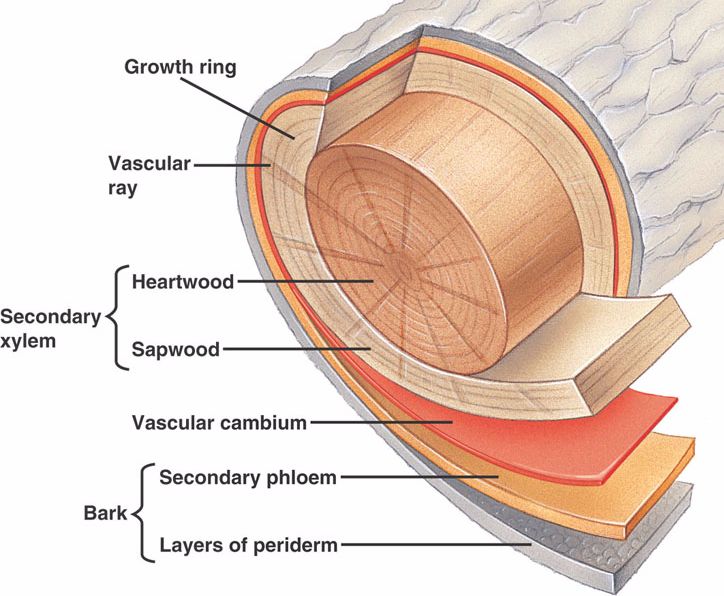
Vascular cambium- generates secondary xylem and phloem. Secondary xylem produced each year gives the thickness of perennial plants and wood= annual growth of rings
Cork cambium protects the stem when the plants' mature, then it dies.
Everything outside the vascular cambium: secondary phloem, cork cambium, cork = bark

Pollinators and flowers have a mutual symbiotic relationship
Flower benefit through seed dispersal and pollination
Pollinators benefit through nectar and pollen for food
Color and fragrance attract the pollinators
Birds see red/pink
Bees use smell

Sincerely,
Nazia

NEXT SCRIBE POST: ***Michael***


Saturday, November 12, 2011

COMPLETE: Class date 11/10/11

Overview of what wecovered today in class:
We began our notes together as a class
Practiced on UP p. 41-42 (do not need to turn in)
We went over terms on UP p. 43 (memorize these if you have not already)
Began "Investigating Inherited Human Traits" lab UP p. 45-50 (homework if not finished in class)
began UP p.55-57 (homework if not finished)

Class notes:
Today we finished class notes on genetics p.1-7, though we did not do page 5. In thenotes we first covered Gregor Mendel, who is also known as "the father ofgenetics". This is because he was the first to analyze patters ofinheritance scientifically. To do this he performed an experiment. In this, hetook the Stamen (male organ with sperm) of a purple garden pea plant andpollonated the Carpel (female organ with ovaries and eggs) of a white gardenpea plant. He next planted the hybrid (offspring of two different true-breedingvarieties) which became a new P (parent) generation. When the plant grew, heanalyzed seven different characteristics: flower color (purple or white),flower position (axial or terminal), seed color (yellow or green), seed shape(round or wrinkled), pod shape (inflated or constricted), pod color (green oryellow), and stem length (tall or dwarf). These flowers in this F1 (children)generation were found to majoritativly have the characteristics of the purplegarden pea! Mendel concluded that the purple flower had the more dominant gene.Based on this, Mendel's 2 Principles arose. His first was his principle ofsegregation, which stated alleles separate during gamete formation (meiosis),and they fuse together again in fertilization. His other principle, that of independent assortment, which we learned of in the last unit.
Today, know what Mendel did as a testcross, the mating of an individual with anunknown gentype with a homozygous recessive genotype. This is used to find outwhat the genotype of the first individual is, whether its homozygous dominant(QQ), homozygous recessive (qq), or heterozygous (Qq).

UP p.41-42:
We did not spend much time on this inclass, we just did it if we finished the quiz on meiosis and we had time. Butbasically what we did is we looked at different human traits and found out ifwe were dominant or recessive. Through this activity we learned that if youhave a dominant gene, and you want to write the genotype, you must write Q_, asyou don't know if it is homozygous dominant or a hybrid.
the detached earlobe is Q_ (dominant) and the attached earlobe is qq (recessive)

UP p. 43 terms YOU MUST KNOW:
genotype: gene sequence that gives a phenotype (ie QqRR, Qq, rr)
homozygous: gene sequence with two of the SAME characteristics (ie QQ, rr)
heterozygous (also known as hybrid): two DIFFERENT characteristics (ie, Qq, Rr note: the uppercase letter is the dominant gene while the lower is recessive)
trait/characteristic: the way something is (ie color of hair, amount of a certain protein) incomplete dominant trait: when both the dominant and recessive genes are expressed (ie QQ green, Qq yellow, qq blue)
pure breeding:an organism with only homozygous genes (ie QQ, rr, GG, bb)
phenotype: physical appearance ( ie attached or detached ear lobe)

Self fertilization: fertilization within the same organism (occurs in plants)
Cross fertilization: fertilization of two different organisms in the same species

Punnett Square: a method to figure out the possible genotypes of a future generation(note: if the genotype has one dominant gene then the gen has a dominanteffect, the exception being an incomplete dominant trait.)


Lab on UP p.45-50:
If you were not here, do this lab for homework, having a partner in the activityis optional.
If you were here and did not complete the lab then complete it for homework.

Punnett Square practice on UP p. 55-57:
We began this in class, do it for homework. (a few notes on this activity: theuppercase/dominant gene ALWAYS comes before the lowercase /recessive gene whenwriting a genotype. Also, a Genotypic ration shows the possible outcomes if theegg and sperm are fertilized, ie 1QQ: 2Gg: 1gg. Always simplify genotypicratios. A Phenotypic ratio shows the ratio of possible physical appearences, ie3orange: 1blue. Also, make sure if you are doing or making a Punnett Square,you ALWAYS HAVE A KEY TO SHOW THE TRAIT, DOMINANT ALLELE, AND RECESSIVE ALLELE.)

Summaryof homework:
readCh. 9 if not done already
do pages 45-50 and 55-57 in the UP
also if your name is ***MARK*** you gotta scribe post commin' at ya
(note: sorry about all the formating issues, not my fault, the computer is just being a dork)

Wednesday, November 9, 2011

Scribe Post 11/9


Today in class:
- Turned in the homework pg.19-37

- Turned in EC pg. 39-40 (if you did it)

- Took quiz on Meiosis

-Worked on pg. 41 in UP after quiz

- Got new notes packet- Genetics & took notes

Notes:
GENETICS - CH.9

Gregor Mendel: 1866
  • 1st to analyze patterns of inheritance scientifically
  • In a garden of an abbey in Austria, bred garden peas
- The reproductive parts of the flower are the stamen and the carpel.
  • The stamen is the male reproductive part that has pollen, which is sperm.
  • The carpel is the female reproductive part with the egg and once its fertilized it turns into a full, ripe flower.
  • One way flowers get fertilized is through self fertilization, where its own stamen fertilizes its own carpel.
  • Parents pass heritable factors (genes) to their offspring
  • Genes retain individuality generation after generation
  • Self vs. Cross fertilization- Self fertilization fertilizes by itself and Cross fertilization is when its pollinated by a different plant
  • Hybrids (Aa)- offspring of 2 different true breeding varieties (Pure breeds)- AA or aa
  • *P generation. F1, F2- F3
  • Monohybrid Crosses- 1 trait
  • Alleles- alternative forms of a gene
  • Dominant(A) vs. Recessive- masked Aa or aa


P- Parent
F1- Offspring
F2- Grandkids
etc.Link
To understand more about genetics or to answer any questions, check out this site:
http://learn.genetics.utah.edu/content/begin/tour/


Homework:

- Read and study UP p. 43-44

- Make sure to know the definitions!
-Make note cards if you need too, but PRACTICE! :)
- Read CH 9 p.142-168

GOOD LUCK!

SINCERELY,
Nazia

NEXT SCRIBE**JEREMY**